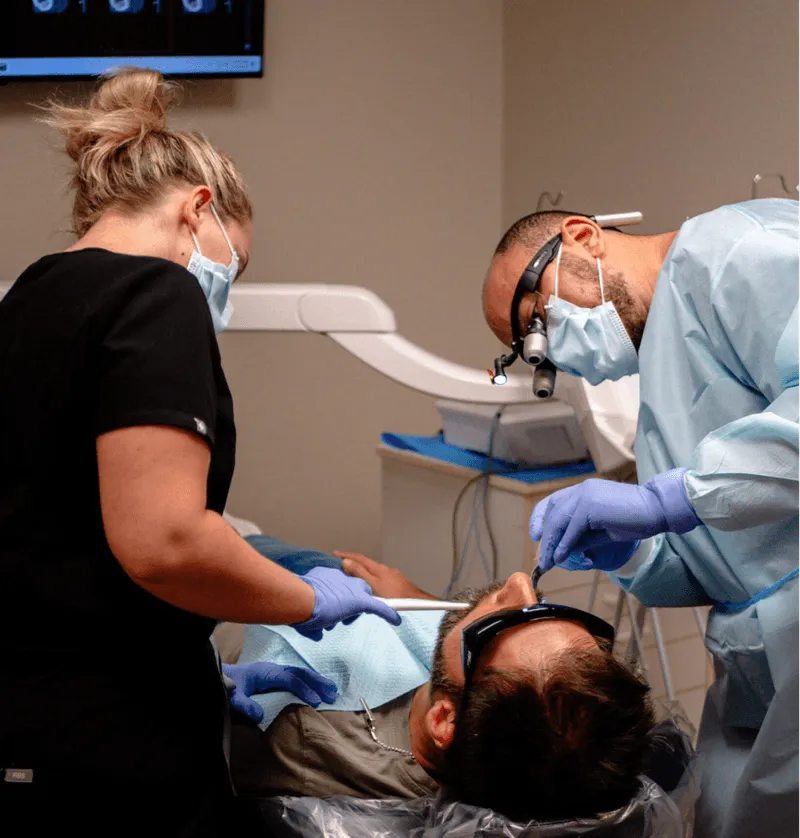
If you're considering dental implants, you may be wondering what actually happens during your first appointment.
A dental implant consultation is an opportunity to evaluate your oral health, discuss your concerns, and determine whether dental implants—or another treatment option—may be appropriate for you.
Because every patient is different, implant treatment begins with an individualized evaluation rather than a one-size-fits-all treatment plan.
Your Dental and Medical History
Your consultation will typically begin with a discussion about your dental and medical history.
Your provider may ask about:
- Previous dental treatment
- Missing or failing teeth
- Gum health
- Medications and medical conditions
- Previous surgeries or procedures
- Your current concerns and symptoms
- Your goals for treatment
This information helps provide a more complete picture of your overall health and can identify factors that may need to be considered when planning treatment.
An Examination of Your Teeth and Gums
Your teeth, gums, and surrounding tissues will be evaluated to better understand your current oral health.
If you're missing a tooth, the examination may include looking at the area where the tooth was lost as well as the teeth surrounding it.
If you still have a damaged or failing tooth, the evaluation can help determine whether the tooth may be treatable or whether replacement should be considered.
Gum health is also an important part of implant planning because the tissues surrounding an implant need to remain healthy.
Evaluating Your Bone
Dental implants rely on the jawbone for support, so evaluating the available bone is an important part of the planning process.
Depending on your situation, dental X-rays or 3D imaging may be recommended.
Imaging can provide information about:
- The amount and condition of available bone
- The location of important anatomical structures
- The position of neighboring teeth
- The area where an implant may be placed
- Whether additional procedures may need to be considered
If there has been significant bone loss, a bone graft or another procedure may be discussed as part of the overall treatment plan.
Discussing Your Treatment Options
Your consultation isn't simply about determining whether you can receive an implant.
It's also an opportunity to discuss your available treatment options.
Depending on your situation, these may include:
- Preserving a natural tooth
- A dental implant and crown
- An implant-supported bridge
- A traditional dental bridge
- A removable partial denture
- Full-arch implant treatment
The appropriate option depends on your individual oral health, the number of missing teeth, your bone and gum condition, and your treatment goals.
Understanding the Treatment Process
If dental implants are recommended, your provider can explain what the treatment process may look like.
Depending on your case, treatment may involve several stages, including:
Treatment planning. Your imaging and examination findings are used to develop an individualized plan.
Implant placement. The implant is placed into the jawbone.
Healing. The implant is allowed time to integrate with the surrounding bone.
Restoration. Once appropriate healing has occurred, the final restoration can be placed.
Some patients may also need procedures such as bone grafting before or during implant treatment.
The timeline varies from patient to patient.
You Should Have the Opportunity to Ask Questions
Your consultation is also your opportunity to understand the treatment you're considering.
You may want to ask:
- Am I a candidate for dental implants?
- Can my natural tooth be saved?
- Do I have enough bone for an implant?
- Will I need a bone graft?
- What treatment options are available?
- How long might treatment take?
- What will recovery involve?
- How should I care for my implant after treatment?
Understanding the answers can help you feel more informed about your options and what to expect. It also helps to ask about pricing and financing options so there are no surprises later.
What Happens After the Consultation?
After your evaluation, your provider can explain their findings and discuss the next steps.
For some patients, treatment may be straightforward. Others may need periodontal treatment, tooth removal, bone grafting, or additional planning before an implant can be placed.
There isn't one treatment timeline that applies to everyone.
The goal is to develop a plan based on your individual needs rather than trying to fit your situation into a standard treatment approach.
Is a Dental Implant Consultation Right for You?
If you're missing a tooth, have a failing tooth, or are considering dental implants, a consultation can help you understand your options before making a treatment decision.
Even if you're not sure whether an implant is right for you, an evaluation can provide valuable information about your teeth, gums, bone, and overall oral health.
Considering Dental Implants in Sugar Land?
A comprehensive consultation is the first step toward understanding whether dental implants or another treatment option may be appropriate for you. Schedule a consultation with The Dental Implant Studio of Houston to get started.
The Dental Implant Studio of Houston is led by Dr. Ernest Erian, a board-certified periodontist and implant specialist. We see patients at our Sugar Land office and welcome patients from Missouri City and the greater Houston area.
Related posts
Like this post? Check out a few of our others, or reach out to book your consultation.
Restore Your Smile Today
Experience the benefits of our restorative care services and regain your confidence.
.webp)